
EXPORTAR ES FÁCIL
How to Price Goods for Export
Pricing goods for export is rarely as simple as using your domestic selling price and adding a small margin. Selling internationally introduces additional costs, new market conditions, different distribution structures, and potential financial risks.
If export prices are set too low, a company may struggle to cover its costs once freight, duties, and distributor margins are included. If prices are set too high, the product may be uncompetitive in the target market.
A structured approach to export pricing helps ensure that the final selling price remains both competitive and profitable. The following steps outline a practical way to calculate and test export prices before entering a new international market.

Start With Your Domestic Price
A useful starting point for export pricing is your existing domestic selling price. This price already reflects the costs of production, overheads, and the profit margin required to operate your business.
However, it is important to break down the domestic price into its component parts. For example, you should understand how much of the price covers manufacturing, how much contributes to overhead costs, and how much represents profit.
Some domestic costs may not apply in export markets. For example, local delivery costs or domestic sales commissions may not be relevant when selling through overseas distributors. By understanding the structure of your current pricing, you can adjust it appropriately for international markets.

Understand the Target Market
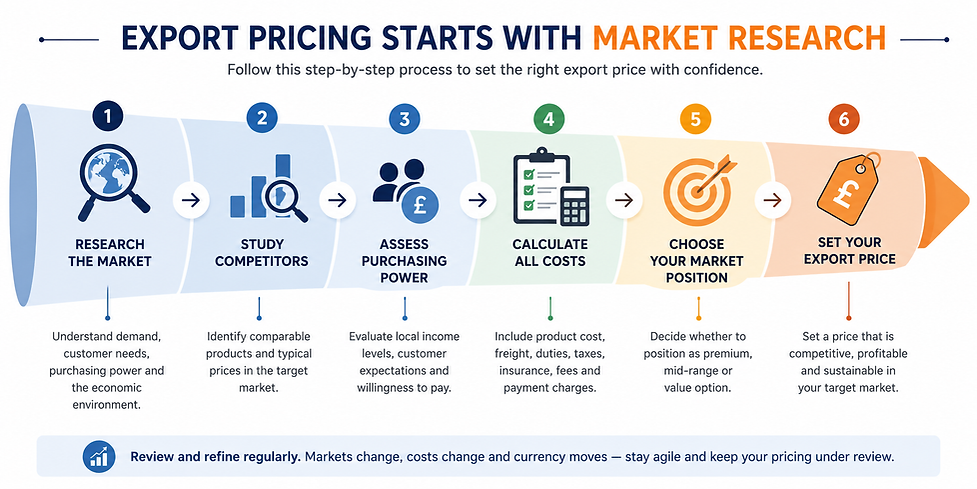
Before finalising an export price, it is essential to research the market you intend to enter. Prices for similar products may vary significantly from one country to another due to differences in competition, purchasing power, and distribution systems.
You should try to determine the typical retail or distributor price for comparable products. This helps you understand whether your product will be positioned as a premium, mid-range, or lower-cost option in the market.
It is also important to consider the economic environment in the destination country. Exchange rates, local income levels, and market demand can all influence how much customers are willing to pay. In some markets, lower margins may be necessary initially in order to establish a presence.
Different Pricing in Different Markets
The example in the graphic below illustrates why export pricing involves far more than simply converting a domestic selling price into another currency. Once export packaging, freight, insurance, documentation, and other international trading costs are taken into account, the exporter's cost base increases significantly.
It also demonstrates that the same product may require different pricing strategies in different markets. Local competition, purchasing power, distributor margins, and customer expectations all influence the final selling price. Successful exporters understand these market differences and structure their prices to ensure that both they and their distribution partners can operate profitably while remaining competitive.

Decide your export pricing method
Companies typically use one of several approaches when setting export prices.
One common method is cost-plus pricing, where the exporter calculates all relevant costs and then adds a suitable profit margin. This approach ensures that the exporter covers expenses, although it may not always produce a competitive market price.
Another approach is market-based pricing, where the exporter studies the market and sets a price that matches or slightly undercuts competing products. This method focuses on competitiveness rather than internal cost structures.
In many cases, exporters also use distributor-driven pricing. In this approach, the exporter starts with the expected retail price in the market and works backwards through distributor margins and other costs to determine the export selling price.
Some companies may also adopt a market-entry pricing strategy, accepting lower margins in the early stages of exporting in order to establish distribution and brand recognition.

Calculate Export Costs
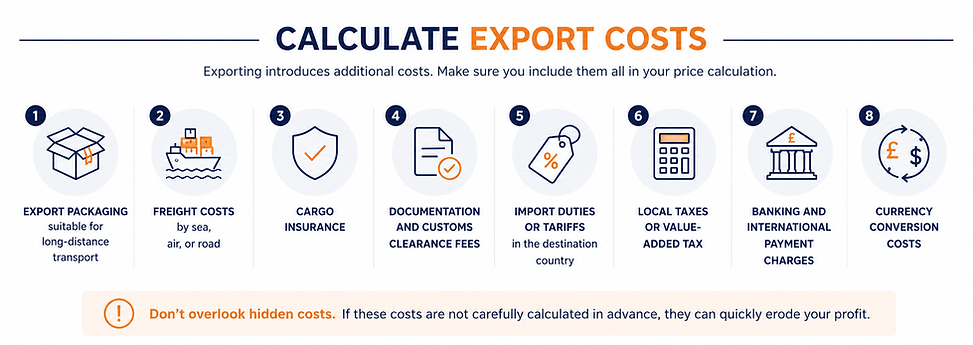
Exporting usually introduces a number of additional costs that must be included in the price calculation. These can vary depending on the product, the destination country, and the chosen delivery terms.
Typical export costs include:
-
Export packaging suitable for long-distance transport
-
Freight costs by sea, air, or road
-
Cargo insurance
-
Documentation and customs clearance fees
-
Import duties or tariffs in the destination country
-
Local taxes or value-added tax
-
Banking and international payment charges
-
Currency conversion costs
If these costs are not carefully calculated in advance, they can quickly erode the exporter’s profit.
Consider Delivery Terms and Responsibilities
The delivery terms agreed with the overseas buyer will determine which party is responsible for transport, insurance, and certain logistical costs.
For example, some agreements require the exporter to deliver the goods to the port of shipment, while others require the exporter to arrange freight and insurance to the destination country. Each arrangement affects the price that the exporter must charge.
Clearly defining responsibilities for transport and risk is essential when calculating the export price. Different delivery terms can significantly change the cost structure of a transaction.
Allow for Distributor or Agent Margins
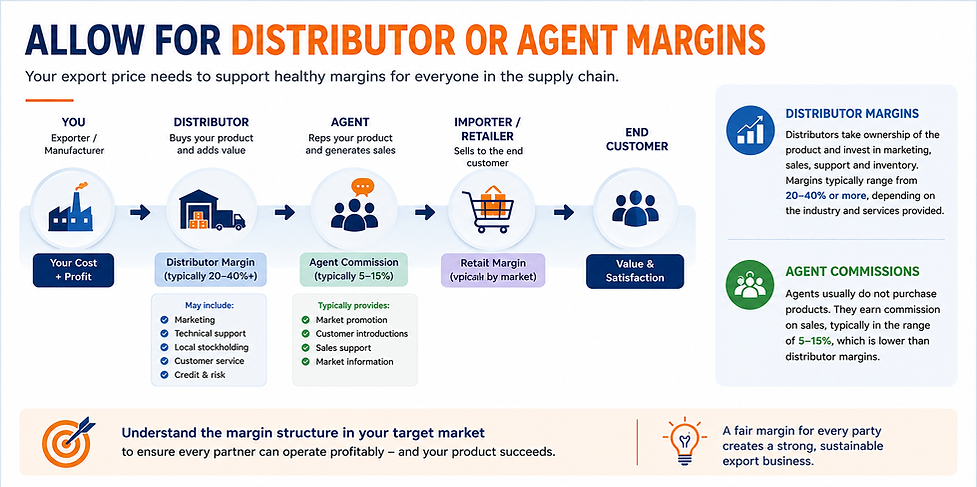
In many export markets, products are sold through distributors, agents, or importers rather than directly to end customers. These intermediaries require a margin to cover their own costs and generate profit.
Distributor margins can vary widely depending on the industry and the services provided. In some sectors, distributors may require margins of 20–40 percent or more, particularly if they are responsible for marketing, technical support, and local stockholding.
Agents typically receive commission on sales rather than purchasing products directly, and their commission levels are usually lower than distributor margins.
When setting export prices, it is important to understand the expected margin structure within the target market and ensure that all parties in the supply chain can operate profitably.
Factor in Payment Risk and Financing
International transactions often involve different payment arrangements from domestic sales. Longer payment terms, unfamiliar customers, and cross-border financial systems can introduce additional risks.
For example, some overseas buyers may request payment terms of 60 or 90 days after delivery. This means the exporter must finance the production and shipment of goods for a longer period before receiving payment.
Companies may also need to consider the cost of export credit insurance or other risk management tools. These financial factors should be reflected in the final export price.
Consider Currency Strategy
Exporters must decide whether to quote prices in their own currency or in the buyer’s currency. Each approach has advantages and disadvantages.
Pricing in the exporter’s currency simplifies accounting and reduces exchange rate risk for the seller, but it may be less attractive to overseas buyers who prefer price certainty in their own currency.
Pricing in the buyer’s currency can make the offer more appealing, but it exposes the exporter to exchange rate fluctuations. Companies often review their export prices periodically to reflect changes in currency values.

Test Your Pricing in the Market
Once a preliminary export price has been calculated, it is useful to test it with potential distributors, agents, or industry contacts in the target market.
These discussions can reveal whether the price is realistic and competitive. Local partners often have a better understanding of customer expectations, distribution costs, and competitor pricing.
If necessary, adjustments can be made before final agreements are signed.
Common Export Pricing Mistakes
Several common mistakes can undermine export pricing strategies.
Some companies underestimate the additional costs involved in exporting and find that their margins disappear once logistics and duties are included. Others fail to research local price levels and discover that their product is significantly more expensive than competing alternatives.
Another frequent mistake is ignoring distributor margins or assuming that overseas partners will accept unrealistic pricing structures.
Careful planning and market research can help avoid these problems.

Example Export Price Calculation
Consider a simplified example.
A company manufactures a product with a domestic selling price of £100. The manufacturing cost is £60, leaving £40 to cover overheads and profit.
When exporting, the company identifies the following additional costs:
-
Export packaging: £3
-
Freight: £8
-
Insurance and documentation: £2
This brings the exporter’s total cost to £73.
If the exporter wishes to maintain a similar margin structure, the export selling price may need to increase accordingly. In addition, if a distributor in the destination market requires a 30 percent margin, the final retail price will need to be high enough to accommodate both the distributor’s margin and the exporter’s profit.
Conclusion
Pricing goods for export requires careful planning and a clear understanding of both costs and market conditions. Companies must consider additional logistics expenses, distributor margins, payment risks, and currency factors when calculating their prices.
By starting with a clear cost structure, researching the target market, and testing prices with potential partners, exporters can develop pricing strategies that are both competitive and sustainable.
Taking the time to plan export pricing properly can significantly improve the chances of long-term success in international markets.
